Every parent wants their child to grow up feeling secure, confident and ready for the world. That sense of inner steadiness doesn’t appear overnight. It’s built through the everyday moments children share with the adults around them, especially during the first years of life.
The adults children watch, listen to and lean on during early childhood shape how they understand themselves and other people. Male role models play a specific and often underestimated part in that process. At TARKA London, our instructors are trained to be exactly that: positive, consistent role models who help children develop physical, emotional and social skills session by session.
What follows is a closer look at why male role models matter in early childhood, what they offer both boys and girls, and how the right presence at the right time shapes a child’s confidence, behaviour and relationships for years to come.
Key Takeaways: Why Male Role Models Matter in Early Childhood
- Children aged 18 months to 7 years absorb behaviour, tone and emotional responses from the adults closest to them.
- Positive male role models help children build emotional safety, confidence and healthy boundaries from an early age.
- Boys and girls both benefit when they see calm, respectful and emotionally available men in their daily lives.
- TARKA London instructors act as trusted role models, building developmental skills through purposeful, structured sessions.
- Small, repeated moments of encouragement and consistency shape a child’s self-belief more than any single event.
Why Early Childhood Shapes Confidence and Behaviour
The years between 18 months and 7 are when children’s brains are building the pathways that govern how they respond to challenge, interact with others and regulate their emotions. What happens during this window compounds. Every interaction, every response, every moment of calm or chaos leaves a mark.
Children at this age aren’t learning through instruction alone. They’re learning through observation. They absorb tone of voice, body language and how the adults around them handle frustration, celebration and conflict. A calm response to a tricky moment teaches a child more than any conversation about behaviour.
Consistency matters here. When the same trusted adults show up repeatedly with patience, warmth and clear expectations, children develop a sense of security. That security becomes the foundation for confidence. Without it, children find it harder to take risks, try new things or recover from setbacks.
How Children Learn Through Watching the Adults Around Them
Young children are natural observers. Before they can articulate what they’ve noticed, they’re already copying it. A child who watches an adult speak with respect will begin to mirror that language. A child who sees an adult handle disappointment with composure starts to understand that a wobble isn’t the end of the world.
A 2025 study published in Frontiers in Developmental Psychology confirms that infants as young as 18 months imitate the behaviours of adults they feel socially connected to. The adults children choose to copy are the adults who show up with warmth and consistency.
This is why the quality of adult presence matters as much as the quantity. Children need adults who are engaged, emotionally available and modelling the behaviours they want to see reflected back. That’s the whole point of purposeful adult involvement in early years.
Why Steady Adult Presence Builds a Child’s Security
Routine and repetition are how young children make sense of the world. When a child knows what to expect from the adults around them, they feel safe enough to explore, to fail and to try again.
This is particularly true during structured sessions where children are stretching their physical and social abilities. TARKA London’s term-time classes are designed around this principle. A trusted instructor who returns each week with the same energy and expectations helps a child feel grounded. That grounding gives them permission to push beyond what felt comfortable last time.
What a Positive Male Role Model Offers a Young Child
Male role models bring something distinct to a child’s world. They offer a different register of warmth, a different style of encouragement and often a different approach to physical play and boundary-setting. None of this replaces what other caregivers provide. It adds another layer to a child’s developmental foundation.
When a man is calm under pressure, when he celebrates effort rather than just outcomes, when he speaks with kindness and follows through on what he says, children absorb all of it. They file it away as a template for how men can be in the world.
How Children Learn Emotional Safety from Men
For many young children, the men in their lives are their earliest examples of how men express emotion. A male role model who names his feelings, who crouches down to a child’s level, who listens before responding, teaches children that emotional openness isn’t a weakness. It’s a strength.
Children who experience this kind of presence build stronger emotional regulation over time. They learn that it’s safe to express frustration, to ask for help and to show vulnerability. Something shifts in how they carry themselves.
How Male Role Models Support Confidence and Boundaries
Encouragement from a male role model carries weight, particularly in physical settings where children are testing their limits. A well-timed “you’ve got this” from a trusted instructor can be the difference between a child who retreats and a child who tries again. You’ll see this play out in every holiday camp session where children push through physical challenges with support.
Boundaries matter just as much. When a male figure sets clear, consistent expectations with warmth rather than authority for its own sake, children learn that structure is something to feel safe inside, not something to resist. That understanding follows them into the classroom, the playground and beyond.
Why Male Role Models Matter for Both Boys and Girls
The conversation around male role models often centres on boys. That’s understandable, but look a little closer and something important emerges. Girls benefit just as much from seeing healthy, emotionally grounded men in their daily lives. The influence simply takes a different shape.
What Boys Learn from Positive Male Examples
Boys are watching. They’re watching how the men around them handle conflict, how they speak to other people, how they respond when something doesn’t go to plan. A positive male role model shows a boy that respect isn’t the same as submission, that self-control is a form of strength and that confidence can be quiet.
In structured settings, boys who see male instructors leading with patience and purposeful energy start to mirror those behaviours themselves. The TARKA London team is built around this kind of purposeful mentorship. They learn that being part of a team means lifting others up. That understanding follows them well beyond the session.
What Girls Learn from Positive Male Examples
Girls who grow up around respectful, emotionally present men develop a clear sense of what healthy relationships look like. They learn that they deserve to be listened to, that their boundaries should be honoured and that trust is built through consistent action rather than words alone.
Research published in Frontiers in Psychology found that a father’s or father-figure’s presence is associated with greater resilience and psychological security in girls. The same principle applies to any trusted male adult in a child’s life, from a family member to a consistent instructor in a developmental programme.
What Positive Role Modelling Looks Like in Everyday Life
Positive male role modelling doesn’t require grand gestures. It lives in the small, repeated moments that children experience day after day. The way an adult speaks during a game, how they handle a child’s frustration, whether they follow through on a promise. These are the building blocks of character.
Small Moments That Shape a Child’s Behaviour
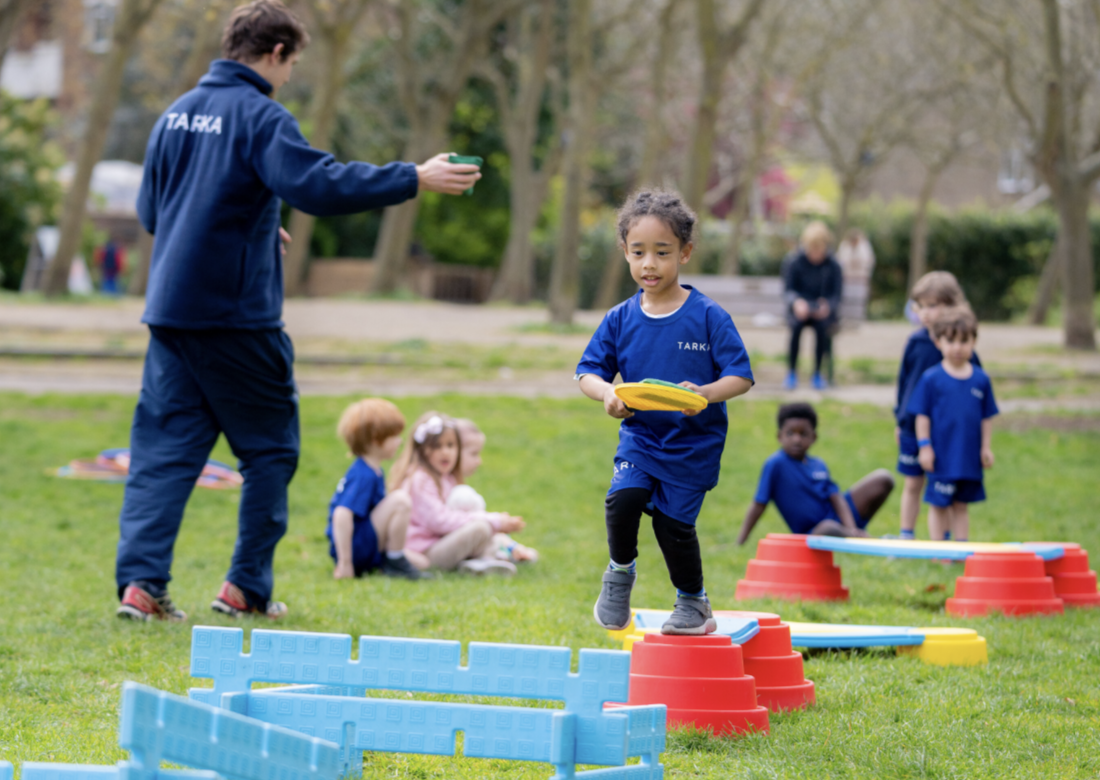
Watch a child play a team game where the rules are clear and the instructor responds to a wobble with calm encouragement rather than disappointment. That child is learning something about resilience that no amount of telling could achieve.
The same applies at home. A father or male carer who narrates what he’s doing during a task, who asks for a child’s opinion, who loses gracefully during a board game, is teaching emotional intelligence in real time. These moments are cumulative. Session by session, day by day, they shape how a child navigates the world. You can find sessions near you through TARKA London’s location finder.
Why Structured Environments Help Children Develop Through Role Modelling
Structured environments give role modelling a consistent framework. When a child attends a weekly class with the same instructor, the same routines and the same expectations, they build a relationship of trust. This is one reason TARKA London works with schools and nurseries across London.
At TARKA London, every session is purposefully designed to develop physical, emotional and social skills. Our instructors are trained to do more than run a fun session. They’re trained to spot the child who needs an extra nudge of encouragement, the child who needs a challenge to stay engaged and the child who just needs to be seen trying.
That kind of attentiveness is role modelling in action. It’s what sets developmental exercise apart from a standard children’s programme.
In Conclusion: Why the Right Role Models Matter Early
The influence of a positive male role model doesn’t arrive in a single moment. It’s cumulative. It’s built through steady presence, consistent behaviour and small acts of encouragement repeated over weeks, months and years. For children aged 18 months to 7, this is the window where those patterns take root most deeply.
Parents often tell us the same thing: it’s not the games their children talk about at dinner, it’s how they felt. Proud. Included. Capable. Whether your child joins TARKA London for a weekly class, a holiday camp or a birthday celebration, the goal is the same: a child who leaves a little more confident than when they arrived.
Ready to see it for yourself? Explore our holiday camps, term-time classes and birthday parties, and join the thousands of London families who’ve already discovered what a difference purposeful, structured sessions can make.
FAQs About Male Role Models in Early Childhood
Why are male role models important for young children?
Male role models show children how men can be calm, respectful and emotionally available. This helps young children build confidence, emotional regulation and healthy expectations for relationships. TARKA London instructors are trained to embody these qualities in every session.
At what age do children start learning from role models?
Children begin absorbing behaviour from the adults around them from as early as 18 months. By observing tone, body language and emotional responses, they form patterns that influence their own social and emotional development throughout early childhood.
Do girls benefit from male role models as much as boys?
Yes. Girls who experience consistent, respectful male presence develop stronger self-worth, clearer relationship expectations and greater resilience. TARKA London’s developmental programmes support all children in building these foundational skills, regardless of gender.
What makes a good male role model for a child?
A good male role model is consistent, emotionally present and leads by example rather than instruction alone. Qualities like patience, follow-through and calm encouragement matter far more than grand gestures. TARKA London’s instructors are selected and trained with exactly these qualities in mind.
How does TARKA London incorporate role modelling into sessions?
Every TARKA London session is designed around developmental goals, not just physical activity. Instructors act as role models by setting clear expectations, celebrating effort and responding to each child’s individual needs. This approach builds confidence, teamwork and emotional resilience session by session.