Every parent wants their child to grow up confident, capable and genuinely excited to learn – and the right activities can make all the difference in those crucial early years.
Why Movement-Based Learning Builds More Than Physical Skills
Every parent wants their child to walk into a room – a classroom, a party, a first day somewhere new – and feel like they belong there. That kind of confidence doesn’t arrive overnight, and it rarely comes from being told to “be confident.” It’s built, session by session, through small moments of trying something hard and getting it right.
Movement is one of the most powerful tools a child has for growing up strong, sociable and self-assured. When a child masters a new skill in front of their peers, works out how to win as part of a team, or pushes through a game they found tricky the week before, something shifts. That win doesn’t stay on the pitch – it follows them into the classroom, the playground and beyond.
This is why the question isn’t really “which sport should my child do” – it’s “what skills will this activity build, and how will those skills show up in the rest of their life?” Physical coordination matters, but so does learning to take turns, cope with losing gracefully, encourage a teammate, and try again when something feels hard. The best developmental activities for young children wrap all of these skills together in ways that don’t feel like lessons at all.
What to Look for in Developmental Activities for Young Children
Not all children’s activities are designed the same way. Some focus purely on skill-specific coaching – teaching a child to kick a ball accurately or swim a length. Others are built around something broader: using movement as a foundation for confidence, communication, resilience and social connection.
When you’re evaluating options for your 3-8 year old, look beyond the sport itself and ask what else is being developed. Are instructors trained to spot the child who needs an extra nudge of encouragement, or the one who’s ready for a bigger challenge? Is there a clear structure that helps children understand what’s expected, or does it feel chaotic and overwhelming? Are skills introduced in age-appropriate progressions, or is everyone expected to keep up regardless of readiness?
The instructors matter more than the equipment. You want people who understand early childhood development, not just someone who’s good at the sport they’re teaching. You want trained staff who can create an environment where a shy child feels safe to try, where a boisterous child learns boundaries, and where every child leaves feeling capable. These aren’t always the most obvious things to ask about, but they’re what make the difference between an activity your child tolerates and one that genuinely builds them up.
Age-Appropriate Activities That Support Confidence and Social Growth
The right activity for a three-year-old looks very different from the right activity for an eight-year-old, even if they’re both labeled “movement classes.” Younger children need activities that blend imagination with physical challenge – games with simple rules, clear beginnings and endings, and plenty of variety to match shorter attention spans. Older children are ready for more complex team dynamics, longer sequences, and games that require strategic thinking alongside physical effort.
Watch a child move through a term of well-designed classes and you’ll notice the change isn’t dramatic – it’s cumulative. A shy child who hangs back in week one is leading a warm-up by week six. A child who struggles to lose gracefully learns, through structured games with clear rules, that trying again is more interesting than giving up. These shifts happen because the activity is designed to meet children where they are and give them repeated opportunities to stretch just beyond their current comfort zone.
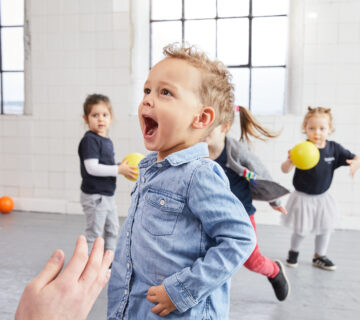
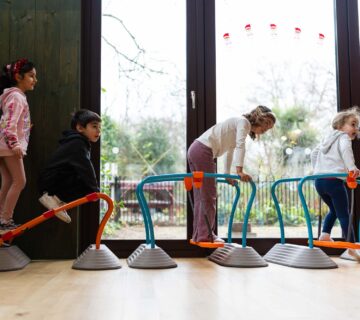
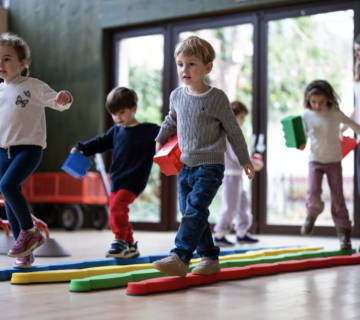
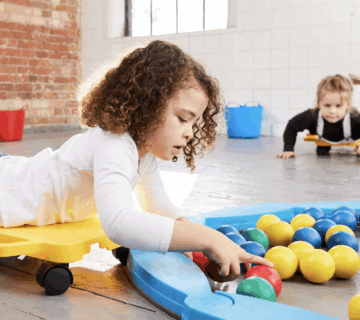
It’s easy to see a movement-based session and think “sports class.” Look a little closer and you’ll see something more deliberate. Every game, every drill and every piece of music has been chosen to develop a specific skill – coordination, communication, resilience, teamwork – wrapped inside an experience that children genuinely can’t wait to come back to. The developmental work is woven in so seamlessly that children experience it as play, which is exactly how young children learn best.
How Structured Play Shapes Long-Term Emotional Development
Structured play isn’t about drilling children or removing spontaneity – it’s about creating a framework where children know what to expect, feel safe to take risks, and experience the satisfaction of mastering something that felt hard at first. This matters far beyond the activity itself. Children who learn to navigate challenge in a supportive environment carry that capability with them into new situations.
That’s not us saying so. As Dr Susan Waisbren, Professor of Paediatrics at Harvard Medical School, put it after observing a session, the way developmental skills are woven into fun, creative activities is seamless. The structure creates predictability, and the predictability creates safety. Within that safety, children are willing to try things that might feel intimidating in less structured settings.
Every class, party and camp is an opportunity – not just for physical development, but for a child to prove something to themselves. When the structure is right, when the instructors are trained to notice and respond, and when the activities are genuinely age-appropriate, children build layers of confidence that compound over time. This is the foundation that helps children walk into unfamiliar rooms feeling like they have something to contribute, which is what every parent hopes for.
Finding the Right Balance Between Fun and Developmental Purpose
The best activities for young children don’t make them choose between having fun and building skills – they deliver both at once. Children should be excited to show up, engaged throughout the session, and talking about what they did afterwards. But beyond the enjoyment, you want to see evidence that something is actually developing. Are they more willing to try new things? Are they talking about their teammates at home? Are they showing up with more confidence each week?
This is why our instructors are trained to do more than run a fun session. They’re trained to spot the child who needs an extra nudge of encouragement, to adapt games in the moment to keep everyone appropriately challenged, and to create moments where every child experiences success. The fun is real – children genuinely love being there – but it’s purposeful fun, designed around what we know about how young children develop confidence, social skills and resilience.
At TARKA, this is the whole point. Our developmental exercise-based programmes are designed around a simple idea: movement is one of the most powerful tools a child has for growing up strong, sociable and self-assured. Whether your child joins us for a weekly class, a week-long holiday camp, or an afternoon celebrating their birthday, the goal is the same – to create an environment where physical activity becomes the vehicle for building confidence, making friends, and proving to themselves that they’re capable of more than they realized.
Parents often tell us the same thing: it’s not the games their children talk about at dinner, it’s how they felt. Proud. Included. Capable. Ready to see it for yourself? Explore our holiday camps, term-time classes and birthday parties, and join the thousands of London families who’ve already discovered what a difference a little structured play can make.